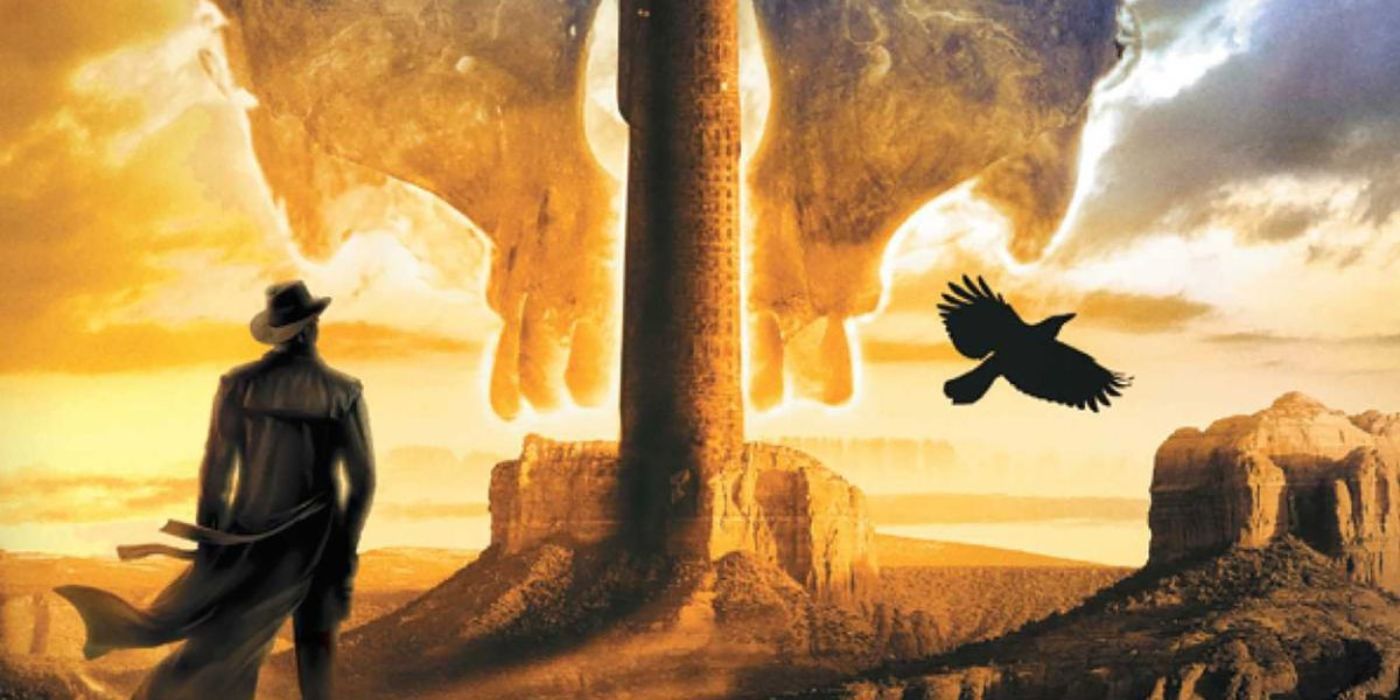
Stephen King didn’t just write a book series. He built a universe, then he nearly died in it, and then he spent decades trying to figure out how to escape. The Dark Tower series isn't your typical fantasy epic. It doesn't follow the clean, structural rules of Tolkien or the political rigidity of George R.R. Martin. It’s weird. It’s jagged. It starts with a guy in a desert and ends with a metafictional twist that still makes fans want to throw the seventh book across the room.
If you’ve never read it, you probably know the opening line. "The man in black fled across the desert, and the gunslinger followed." It’s iconic. But what happens after that is a sprawling, multi-genre hallucination that links together almost every single book King has ever written. It’s the connective tissue of a career spanning half a century.
The Dark Tower Series: A Story That Refused to Stay on the Page
Most people think this is a Western. It isn't. Not really. The Gunslinger, the first book, feels like a fever dream written by a guy who watched too many Clint Eastwood movies while listening to a lot of poetry. Roland Deschain is the last of his kind, a knight with a revolver, chasing a sorcerer through a wasteland. But then the second book, The Drawing of the Three, happens. Suddenly, we’re in 1980s New York City. We're dealing with heroin addiction and split personalities.
It’s jarring. It’s supposed to be.
King started this when he was nineteen. He was a kid at the University of Maine, obsessed with The Lord of the Rings and the poem "Childe Roland to the Dark Tower Came" by Robert Browning. You can see the evolution of a writer's entire life within these pages. The tone shifts from the stark, sparse prose of the late 70s to the bloated, maximalist style of the late 90s.
Honestly, the middle of the series is where it peaks. The Waste Lands and Wizard and Glass are arguably some of the best fiction King has ever produced. You’ve got a sentient, suicidal monorail named Blaine who loves riddles. You’ve got a tragic prequel romance that explains why Roland is such a hollowed-out shell of a man. It’s peak storytelling.
Why the "Connected Universe" Actually Matters
You'll hear people say you need to read thirty other books to understand the Dark Tower series. That’s a lie. You don’t need to read Insomnia or The Stand or Salem’s Lot to follow Roland’s quest.
But it helps.
The Crimson King, the big bad of the series, shows up in various forms across the King-verse. Father Callahan from Salem's Lot literally walks into the fifth book, Wolves of the Calla, and joins the main cast. It was the "Marvel Cinematic Universe" before that was even a concept people cared about. It turns the act of reading Stephen King into a giant scavenger hunt.
- Hearts in Atlantis provides the backstory for the "Breakers."
- The Stand features the same villain, Randall Flagg, under a different alias.
- The Eyes of the Dragon is basically a companion piece to the Tower’s lore.
The Meta-Twist That Changed Everything
Here is where it gets controversial. In 1999, Stephen King was hit by a van while walking on a road in Maine. He almost died. This event didn't just affect his life; it completely rewrote the ending of the Dark Tower series.
He put himself in the books.
Literally. Roland and his "ka-tet" (his group of companions) travel to our world and meet a fictionalized version of Stephen King. It’s a move that some readers find incredibly arrogant and others find brilliantly vulnerable. King was terrified he would die before finishing the story. He rushed the final three books—Wolves of the Calla, Song of Susannah, and The Dark Tower—to make sure the tale was told.
You can feel that rush. The ending is divisive. Without giving away the massive spoiler, it’s a cycle. It’s about the journey, not the destination, which is a cliché until you actually reach the top of that Tower and realize what King is trying to say about the nature of obsession. Roland isn't a hero. He’s an addict. His drug is the Tower, and he’ll sacrifice anyone—children, lovers, friends—to get there.
The Misconception of the Movie
We have to talk about the 2017 movie. It was a disaster. Not because of Idris Elba or Matthew McConaughey—they were actually great casting choices. It failed because it tried to cram 4,000 pages of lore into a 95-minute PG-13 action flick.
The movie tried to be a sequel to the books rather than an adaptation. It’s a nuance that went over the heads of general audiences. If you’ve only seen the film, you haven't experienced the story. You’ve seen a distorted reflection in a broken mirror. The real weight of the story is in the dialogue, the "High Speech," and the slow-burn world-building.
How to Actually Read the Series Without Getting Lost
If you're jumping in now, don't overthink the reading order. Just start with book one.
1. Start with the "revised" version of The Gunslinger. King went back years later and polished the first book to make it fit the tone of the later novels better. It flows much more smoothly.
2. Don't stop if the first book feels weird. The Gunslinger is a mood piece. The Drawing of the Three is a propulsive thriller. They are completely different animals. If you aren't hooked by the end of book two, then the series probably isn't for you.
3. Read The Wind Through the Keyhole last. Even though it’s technically "Book 4.5," it was written years after the series finished. It’s a "story within a story" and works much better as a nostalgic return to Mid-World once you’ve already finished the main journey.
Practical Tips for the Long Haul
- Pay attention to the numbers. 19 and 99 show up everywhere. It’s not just flavor text; it’s a structural part of the reality King built.
- Audiobooks are your friend. George Guidall and Frank Muller are the two narrators for this series, and they are legendary. Muller, specifically, captured the voice of these characters so well that King himself said he could no longer write the characters without hearing Muller's voice in his head.
- Keep a "King Map." If you find yourself wondering who a side character is, they probably appeared in a short story twenty years prior. Don't stress it, just enjoy the "aha!" moments when they happen.
The Dark Tower series is a testament to the idea that a story can be bigger than its creator. It’s messy, it has plot holes you could drive a truck through, and the ending will leave you thinking for weeks. It’s the definitive work of a writer who decided to throw every idea he ever had into one giant pot and see if it exploded.
Go find a copy of The Gunslinger. Sit in a quiet room. Read that first line. See where the path of the Beam takes you. Just remember: there are other worlds than these.